You don’t hate running, you’re just doing it wrong
I went from 2:22 to 1:32 half marathon with minimal effort and you can do it too.
Most beginners turn every run into a test. You leave at a pace that feels fine, and four minutes later your breathing is ugly and the rest is survival.
Do that a few times and you conclude running isn't for you. You have bad genetics, you're never going to be fast, never going to like it.
This was me for almost three years.
I kept going because it was the only time I was alone with my brain. But nothing improved. Every run hurt, my pace never moved, and I assumed that was just the runner I am.
In 2021, I ran my first half marathon and got absolutely humbled, finishing in 2h 22m.
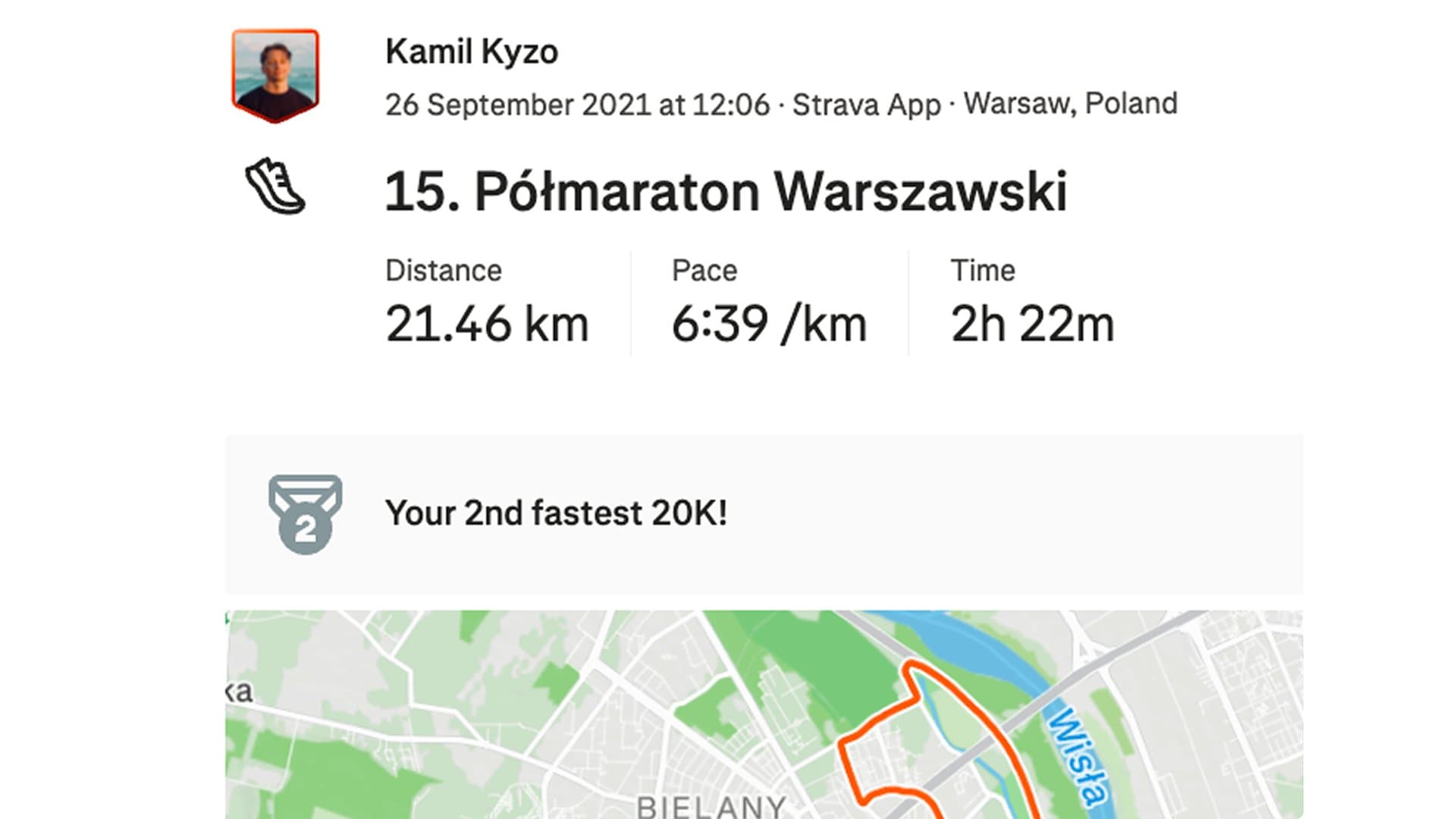
Eleven months later, I ran the same half marathon in 1:32 with a full marathon in 3:24 right after.
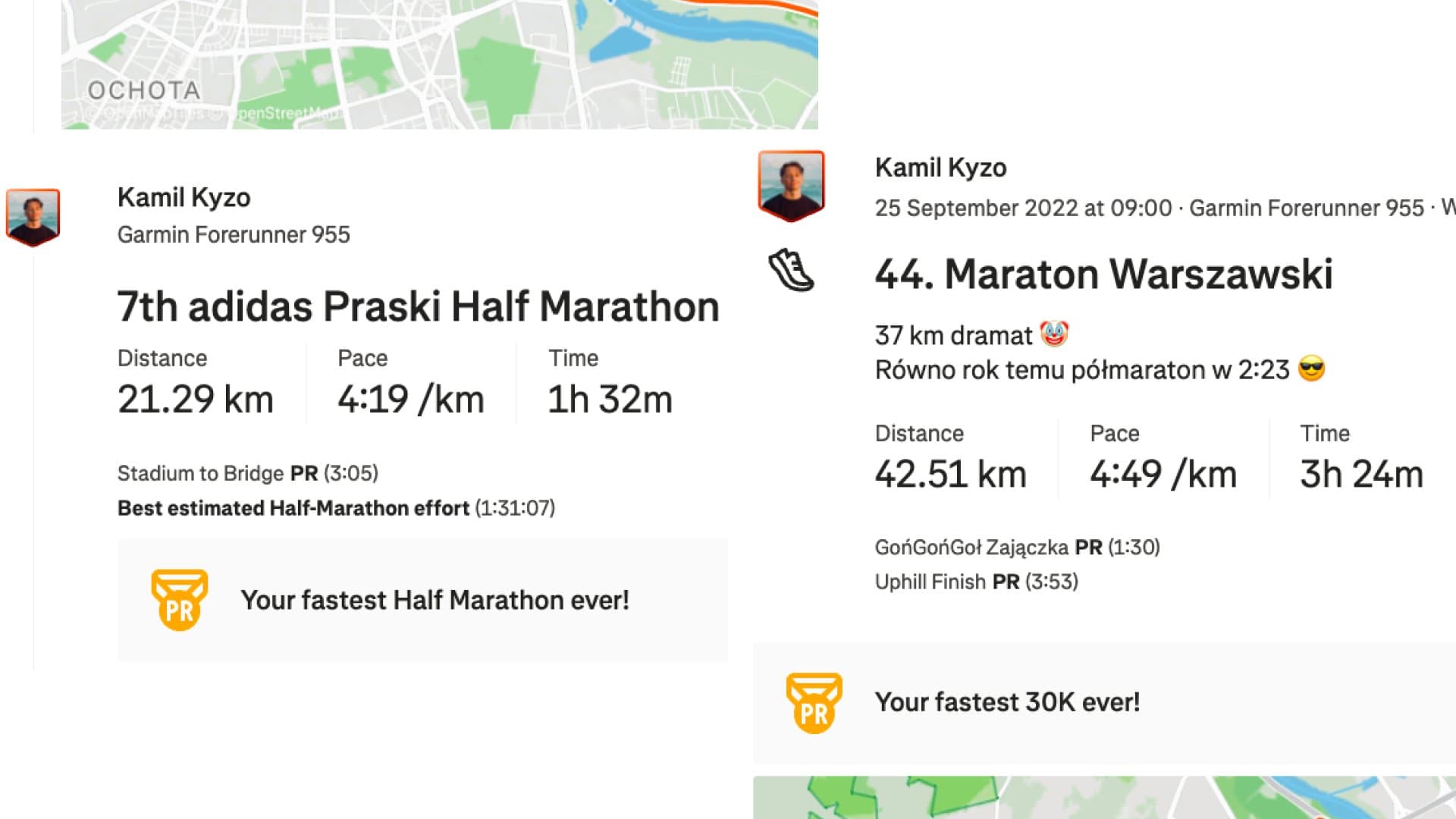
I didn’t suddenly discover elite genetics. I didn’t hire a professional coach, start running every day, or reorganize my entire life around training.
One fundamental thing changed: I discovered the 80/20 rule.
The basic idea: a lot of easy, a little hard
The 80/20 rule says that roughly 80 percent of your training should be done at a low intensity, while the remaining 20 percent can be harder.
This doesn’t mean you need to open a spreadsheet after every run and calculate whether your weekly split was exactly 81.4 to 18.6. The percentages are a useful direction, not a law. The important idea is much simpler: most of your running should feel genuinely easy, some of it should feel controlled and hard, and almost none of it should be all-out.
My mistake was spending too much time in the middle. Not hard enough to push VO2max, not easy enough to build a base.
In other words, the secret sauce is to run slow, to run fast.
What is Zone 2?
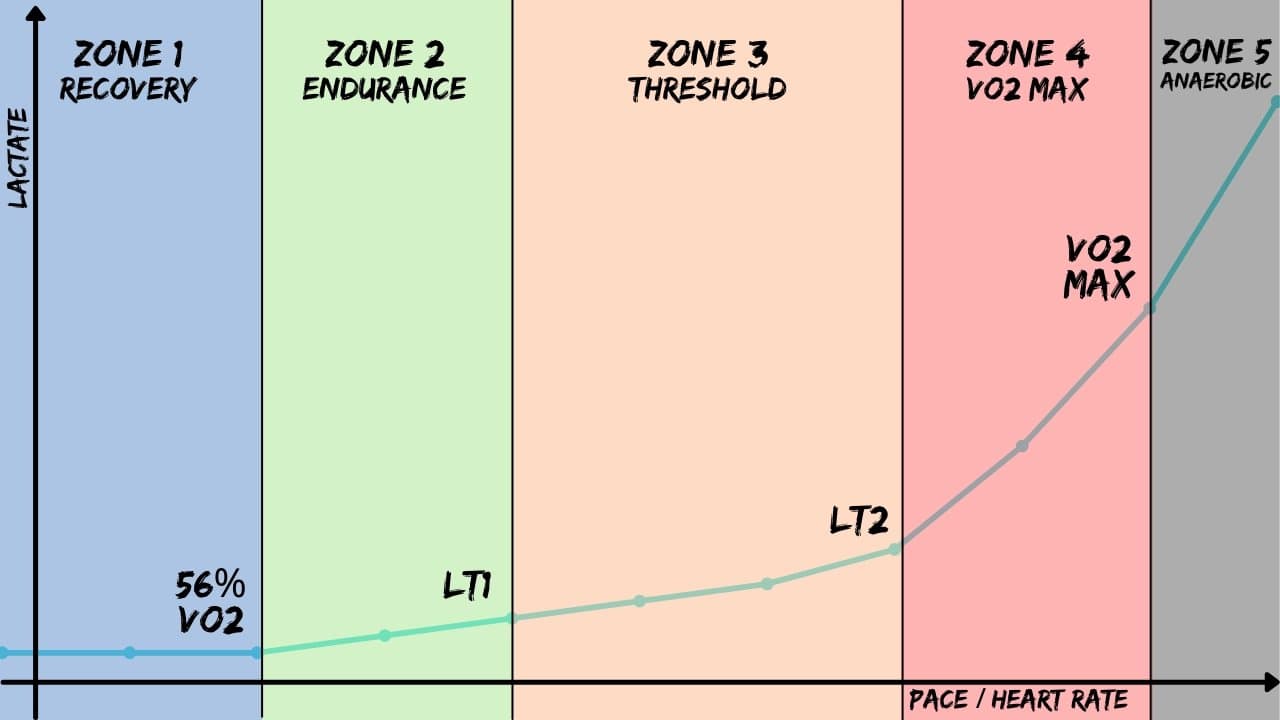
The phrase “Zone 2” is slightly confusing because different watches, apps, and coaches use different systems, but for your own sake you should understand two things:
- biologically, Zone 2 is an easy aerobic intensity below your first lactate or ventilatory threshold. Your body is still producing lactate, but it is able to clear and reuse it at roughly the same rate, so the concentration in your blood remains relatively stable.
- practically, Zone 2 means running slowly enough that your breathing stays controlled and you can still hold a normal conversation.
The second definition is more useful than blindly trusting whatever number your Garmin, Apple Watch, or Strava happens to label as Zone 2 (these in 99% cases will be wrong). Wrist devices estimate your zones using formulas that may or may not fit your physiology.
How easy should an easy run feel?
An easy run should feel slower than you instinctively think it should.
You should be able to speak in complete sentences without having to pause for breath. Your breathing can be elevated, but it should remain controlled. On a scale from one to ten, the effort should feel like roughly a three. You should finish believing that you could have continued for another ten or fifteen minutes.
Walking is completely fine, especially on hills. The goal is to control the effort, not to protect your ego by technically running every meter.
Why would running slowly make you faster?
“You have to run slow to run fast” sounds like a contradiction, but the idea is fairly straightforward.
Easy running lets you accumulate a meaningful amount of aerobic training without creating so much fatigue that you need several days to recover. Over time, your body becomes better at delivering oxygen to your muscles and using it to produce energy. You develop more mitochondria, improve capillary density, and become more efficient at sustaining movement for a long time.
As those systems improve, you begin to run faster at the same heart rate. A pace that once pushed you above 150HR might later keep you comfortably below it.
Easy running is not the only thing you need forever. Hard intervals are useful because they train qualities that slow running doesn’t. But the hard work only works properly when it sits on top of a large aerobic base.
There was also a less scientific benefit: running became genuinely enjoyable. Before discovering Zone 2, every session felt like a negotiation with myself about how much longer I had to suffer. Once I slowed down, I started having days when I went outside for a quick run and didn’t want to stop.
Running stopped feeling like a fitness exam. It became FUN.
Your new training routine
▲ Day 1 (do it today): call or run with someone
My first ever Zone 2 run, I tried to keep my heart rate below 150 beats per minute. That number turned out to be roughly accurate for me, but it is not a universal limit. For another person, Zone 2 might end at 135HR or 160HR (Heart Rate).
On this first run, I managed to run only about 500 meters before crossing the threshold of 150HR. I then walked for another 500 meters until my heart rate dropped, ran for 500 meters again, and walked again.
It felt incredibly stupid. I had gone outside to run, but I was spending half the session walking. I felt slow, unfit, and embarrassed whenever someone passed me. But this was the first time I was actually teaching my body how to keep the HR low.
The best trick I found while preparing for the marathon was calling my girlfriend during long runs. If I could talk to her normally, I was probably running easily enough. If she could hear me fighting for oxygen between every few words, I needed to slow down.
This is known as the talk test, and it is surprisingly useful. You don’t need a laboratory, a lactate meter, or an expensive watch. You just need to notice whether you can still form a normal sentence.
So here comes your first real task for today:
Go for a 30-45minute run slowly enough that you can speak in complete sentences. Run with someone an talk, or call your friend and be on the phone with them the whole time. As soon as your breathing becomes too heavy, walk until it settles, then start running again.
Don’t worry about your pace, distance, or how often you need to walk. Just do this for 30-45 minutes.
If you have a watch, try to understand at what Heart Rate your breath starts to get heavier, then try to never reach this moment. Your first objective is not to prove that you can run continuously. It is to complete one session that feels stupidly easy.
That is where the progress starts.
▲ Weeks 1 to 4: make easy running feel normal
Four days after my first run I could run 800 meters before crossing 150HR. Two weeks later, I could do about 2km continuously at the same heart rate.
That progress felt incredible because it was the first time I could clearly see my body adapting. I wasn’t forcing myself to run faster. I was running at the same easy effort and watching my pace slowly improve underneath me.
The number 150HR wasn’t the main point. I accepted that I needed to slow down, and sometimes walk, rather than turning every run into another test.
Start doing two runs per week. A third short run is useful, but optional.
Your long-term goal is to run easily for around 90 minutes, but you should not jump directly from doing very little to a 90-minute run. Novice runners have a higher rate of running-related injuries than experienced recreational runners, and sudden increases in running distance appear to increase that risk.
Start here:
• Sunday - 60/90minute easy slow zone2
• Wednesday - 30 minute easy slow zone2
• Monday/Friday - (optional) easy slow zone2
Target at the end of the first month is a total of 150-200 minutes of Zone2 weekly.
All of this can include walking. If you run for five minutes and then need to walk for one minute, do that for the entire session. Measure the long runs by time, not distance. Distance encourages you to chase a finishing time. A time goal allows you to slow down, walk when necessary, and accumulate easy aerobic work without turning the run into another test.
There are no intervals during these first four weeks. Your only job is to understand easy effort and complete eight runs. The optional Friday sessions are a bonus.
▲ Weeks 5 and beyond: add a little hard running
Once you can complete the first four weeks without every run feeling like a battle, replace the Wednesday easy run with a controlled interval session.
Your week now looks like this:
Minimal training routine:
• Tuesday/Friday - 30 to 45 minutes easy, optional
• Wednesday - 40-minute interval session
• Sunday - 90-120 minutes easy
For the first three weeks, the interval session should look like this:
• Warm up: Run easily for 10 to 15 minutes.
• Training: Run hard for 1 minute, rest for 2 minutes; repeat 6 times
• Cool down: Finish with another 10 to 15 minutes of easy running.
That gives you only six minutes of genuinely hard running. It may not sound like much, but it is enough when you are starting.
After three weeks, provided you can keep every repetition controlled and roughly equal, progress to six repetitions of two minutes hard with two minutes easy between them. Later, you can move to five repetitions of three minutes hard.
Do not increase the length, speed, and number of repetitions at the same time. Change one thing, allow your body to adapt, and only then progress again.
How hard should the intervals feel?
Hard does not mean full gas.
The effort should feel like a seven or eight out of ten. Your breathing should be heavy and you probably won’t be able to speak in complete sentences, but you should remain in control of your pace.
The first and final repetition should look roughly similar. If you fly through the first two and spend the last four trying not to die, you started too fast. You should finish the session feeling that you could complete one more repetition if someone forced you.
This is the difference between training and testing. A maximal effort tells you how fit you are today. A controlled effort makes you fitter for the future.
Research on endurance training generally supports combining a large amount of low-intensity work with a much smaller amount of harder training, although the exact best distribution depends on the runner, training history, and how intensity is measured.
What should happen over time?
Don't make your easy runs faster. Keep the effort easy and let the pace improve on its own.
At first you'll walk every few minutes to control your breathing. Then you'll run longer before walking. Eventually you'll cover the whole route without stopping.
Later the same thing happens to pace. A speed that used to push you above your easy zone starts to feel comfortable. Same route, same heart rate, several minutes faster.
That's the progress you're looking for.
The thing that stops it is drift. You feel good, so you speed up. Someone passes you, so you speed up again. By the last kilometer you're chasing a Strava PR. You finish tired and satisfied because it felt productive. It wasn't an easy run anymore.
Running faster occasionally because you feel great is fine. The problem is when it happens on almost every run. Keep the easy days easy and save the urge to prove something for the interval session or an actual race.
How to measure whether it's working
Every four weeks, run the same flat route for 30 minutes at your normal easy effort.
Don't race it. Keep the effort conversational and record:
[ week | average heart rate | average pace | distance | how it felt ]
You're improving if you can run faster at the same heart rate, hold the same pace at a lower heart rate, go further before walking, or finish feeling less tired.
Heart rate also responds to heat, hills, sleep, stress, dehydration, caffeine and illness. One bad run means nothing. Read the trend across several weeks, not a bad Tuesday.
The first improvement might not show up on Strava at all. It might just be noticing you no longer spend the whole day negotiating with yourself before going outside.
You don't need expensive equipment
You can do this without a watch. The talk test and perceived effort are enough to start, and the talk test lines up with real physiological thresholds closely enough to work as a control.
A watch helps later, when you want to see how your pace changes at the same heart rate. A chest strap reads more reliably during intervals, though you don't need one for easy running.
Don't delay your first run to calculate your lactate threshold, buy the right Garmin or find the perfect shoes. Comfortable shoes and a clock are enough.
One final note about pain
Breathlessness, tired legs and some soreness after unfamiliar exercise are normal.
Sharp or localised pain, pain that changes how you run, or pain that keeps getting worse is not. Stop the session instead of pushing through. This is a training framework, not a rehab plan.
Start with 8 easy runs
The first few will feel ridiculous. You'll spend half the session walking. You'll get passed by people who look like they're barely moving. You'll look at your pace and wonder how this could possibly make you faster.
Give it four weeks before you judge it.
Eight easy runs. Walk whenever your breathing gets away from you. Ignore your pace and watch what happens to how long you can run continuously.
Then add six hard minutes a week.
That's the whole system. A lot of easy running, a little hard running, and enough consistency to let both work.
You may discover you never hated running. You only hated turning every run into a test.
More resources if you want to dive deeper:
- What Is “Zone 2 Training”? Experts’ Viewpoint on Definition, Training Methods, and Expected Adaptations
- What Is Best Practice for Training Intensity and Duration Distribution in Endurance Athletes?
- Polarized vs. Threshold Training on Endurance Sport Performance
- The Talk Test as a Tool for Prescribing and Monitoring Exercise Intensity
- For the harder part of the plan, Stephen Seiler also has a useful video on when and how to add interval training
- Training Intensity Zones and the Importance of Polarized Training
- Huberman Lab clip on weekly Zone 2 cardio
if you tried running and didn't like it, read this. bookmark if you want to become a runner one day

x.com/i/article/2087…